

|

| MOQ: | 1 Set |
| Price: | USD 3800-6500 / Set |
| Standard Packaging: | Glass parts foam wrapped in cartons, vessel body in plywood case with shock indicator |
| Delivery Period: | 15-20 working days after deposit |
| Payment Method: | T/T, L/C, Western Union, |
| Supply Capacity: | 80 Sets per Month |
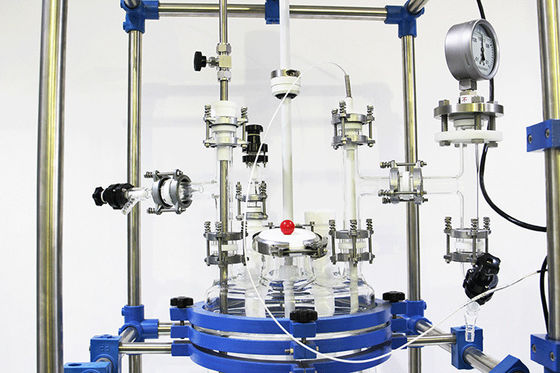
The FPGR-P20UV photochemical glass reactor is a 20 litre jacketed borosilicate 3.3 vessel built for light driven chemistry in the laboratory and pilot plant. A quartz immersion well passes vertically through the centre of the vessel cover, so a low pressure mercury lamp at 254 nm or a high pressure lamp at 365 nm can be submerged directly in the reaction mass while the jacket circulates coolant to remove the heat that lamps inevitably release. Chemists who previously ran photochemistry in thin film beakers and borosilicate tubes now obtain reproducible conversions in a fully instrumented, vacuum tight stirred tank.
Because the immersion well is manufactured from high purity fused quartz, transmission below 300 nm is preserved and the vessel body itself is formed from 3.3 borosilicate glass with a low alkali release. Every wetted surface is either borosilicate glass, fused quartz or virgin PTFE, so halogenated solvents, photoacid generators and metal catalysts contact nothing that can leach or catalyse a side reaction. The separate cover and body design lets an operator lift the lid with the lamp assembly attached, inspect the well for fouling, and clean the interior without disconnecting the jacket circuit.
Key Features| Parameter | Specification |
|---|---|
| Model | FPGR-P20UV |
| Nominal Capacity | 20 L |
| Vessel Material | Borosilicate glass 3.3, low alkali release |
| Immersion Well | Fused quartz, 45 mm OD, sealed PTFE head |
| Lamp Compatibility | 254 nm low pressure mercury, 365 nm high pressure, up to 400 W |
| Jacket Working Temperature | -20 C to 150 C |
| Jacket Connection | 16 mm glass barbs, silicone or PTFE hose |
| Stirring Speed | 50 to 600 rpm, frequency controlled |
| Motor Power | 140 W gear motor |
| Ultimate Vacuum | -0.098 MPa |
| Cover Ports | Six necks: lamp well, stirrer, condenser, thermometer, feed, spare |
| Discharge Valve | PTFE flush bottom valve, zero dead angle |
| Power Supply | 220 V, 50/60 Hz, single phase |
| Overall Dimension | 650 x 650 x 1900 mm |
The vessel suits vitamin D photoisomerisation, photochlorination of derivatives, photo-induced radical polymerisation, singlet oxygen oxidation of terpenes, and the UV curing studies that precede scale up in fine chemical and cosmetic ingredient development. Pharmaceutical process groups use it to generate photodegradation impurity profiles for forced degradation studies, while academic laboratories run it for visible light photocatalysis when the immersion well is replaced by a blue LED insert. Because the jacket can hold sub ambient temperature, exothermic photobrominations are controlled without a separate cryostat loop.
Packaging & Quality AssuranceEach reactor is pressure tested at 0.2 MPa, helium leak tested at the jacket and well seals, and supplied with a lamp alignment certificate. Glassware is wrapped in polyethylene foam, boxed individually, and the jacketed body travels in a plywood case with a shock indicator. A spare well O ring set and a PTFE gasket kit ship with the unit. The vessel carries a twelve month warranty against manufacturing defects; breakage in transit is replaced free of charge after photographic confirmation. Installation, lamp commissioning and operator training are available from our engineering team for overseas projects.
|
|
| MOQ: | 1 Set |
| Price: | USD 3800-6500 / Set |
| Standard Packaging: | Glass parts foam wrapped in cartons, vessel body in plywood case with shock indicator |
| Delivery Period: | 15-20 working days after deposit |
| Payment Method: | T/T, L/C, Western Union, |
| Supply Capacity: | 80 Sets per Month |
The FPGR-P20UV photochemical glass reactor is a 20 litre jacketed borosilicate 3.3 vessel built for light driven chemistry in the laboratory and pilot plant. A quartz immersion well passes vertically through the centre of the vessel cover, so a low pressure mercury lamp at 254 nm or a high pressure lamp at 365 nm can be submerged directly in the reaction mass while the jacket circulates coolant to remove the heat that lamps inevitably release. Chemists who previously ran photochemistry in thin film beakers and borosilicate tubes now obtain reproducible conversions in a fully instrumented, vacuum tight stirred tank.
Because the immersion well is manufactured from high purity fused quartz, transmission below 300 nm is preserved and the vessel body itself is formed from 3.3 borosilicate glass with a low alkali release. Every wetted surface is either borosilicate glass, fused quartz or virgin PTFE, so halogenated solvents, photoacid generators and metal catalysts contact nothing that can leach or catalyse a side reaction. The separate cover and body design lets an operator lift the lid with the lamp assembly attached, inspect the well for fouling, and clean the interior without disconnecting the jacket circuit.
Key Features| Parameter | Specification |
|---|---|
| Model | FPGR-P20UV |
| Nominal Capacity | 20 L |
| Vessel Material | Borosilicate glass 3.3, low alkali release |
| Immersion Well | Fused quartz, 45 mm OD, sealed PTFE head |
| Lamp Compatibility | 254 nm low pressure mercury, 365 nm high pressure, up to 400 W |
| Jacket Working Temperature | -20 C to 150 C |
| Jacket Connection | 16 mm glass barbs, silicone or PTFE hose |
| Stirring Speed | 50 to 600 rpm, frequency controlled |
| Motor Power | 140 W gear motor |
| Ultimate Vacuum | -0.098 MPa |
| Cover Ports | Six necks: lamp well, stirrer, condenser, thermometer, feed, spare |
| Discharge Valve | PTFE flush bottom valve, zero dead angle |
| Power Supply | 220 V, 50/60 Hz, single phase |
| Overall Dimension | 650 x 650 x 1900 mm |
The vessel suits vitamin D photoisomerisation, photochlorination of derivatives, photo-induced radical polymerisation, singlet oxygen oxidation of terpenes, and the UV curing studies that precede scale up in fine chemical and cosmetic ingredient development. Pharmaceutical process groups use it to generate photodegradation impurity profiles for forced degradation studies, while academic laboratories run it for visible light photocatalysis when the immersion well is replaced by a blue LED insert. Because the jacket can hold sub ambient temperature, exothermic photobrominations are controlled without a separate cryostat loop.
Packaging & Quality AssuranceEach reactor is pressure tested at 0.2 MPa, helium leak tested at the jacket and well seals, and supplied with a lamp alignment certificate. Glassware is wrapped in polyethylene foam, boxed individually, and the jacketed body travels in a plywood case with a shock indicator. A spare well O ring set and a PTFE gasket kit ship with the unit. The vessel carries a twelve month warranty against manufacturing defects; breakage in transit is replaced free of charge after photographic confirmation. Installation, lamp commissioning and operator training are available from our engineering team for overseas projects.