

|

| MOQ: | 1 Set |
| Price: | USD 9500-15500 / Set |
| Standard Packaging: | Foam lined cartons for glass, plywood case for frame and control cabinet |
| Delivery Period: | 25-35 working days after deposit |
| Payment Method: | T/T, L/C, Western Union, |
| Supply Capacity: | 25 Sets per Month |
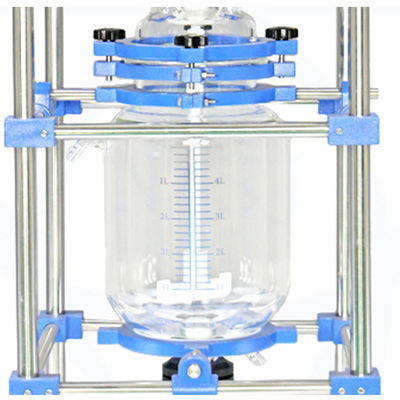
The FPGR-T20D tandem reactor couples two 20 litre jacketed borosilicate vessels on a single stainless frame, with a jacketed transfer line and PTFE valve between them so that a two stage synthesis can run without an intermediate hold tank. The first vessel normally carries the reaction while the second receives the crude for quench, pH adjustment, washing or crystallisation. Each vessel has its own jacket circuit, its own agitator drive and its own temperature sensor, which means stage one can be held at reflux while stage two is cooled to zero, all within one footprint of roughly 1.6 square metres.
Both vessels are formed from 3.3 borosilicate glass and share the same cover port pattern, so condensers, dropping funnels and pH probes can be moved from one to the other without adaptors. A programmable logic controller sequences the two drives, the jacket circulation valves and the transfer valve, and a seven inch touchscreen records the temperature and agitation profile of the whole campaign as a batch report. For laboratories that currently move a batch between two separate reactors on a trolley, the tandem arrangement removes the transfer losses, the cleaning of a third vessel and the operator exposure that goes with a manual pour.
Key Features| Parameter | Specification |
|---|---|
| Model | FPGR-T20D |
| Configuration | Two vessels on one frame, cascade transfer |
| Capacity Per Vessel | 20 L, 40 L total |
| Vessel Material | Borosilicate glass 3.3 |
| Jacket Temperature Range | -20 C to 150 C per vessel |
| Stirring Speed | 50 to 600 rpm per drive |
| Motor Power | 140 W per vessel |
| Ultimate Vacuum | -0.098 MPa |
| Transfer Line | Jacketed PTFE valve and line, 25 mm bore |
| Control | PLC with 7 inch HMI touchscreen, batch data logging |
| Frame | SUS304 welded, levelling feet |
| Power Supply | 220 V, 50/60 Hz, single phase |
| Overall Dimension | 1400 x 800 x 2000 mm |
The cascade arrangement fits two stage organic synthesis where an unstable intermediate must be quenched immediately, peptide and oligonucleotide work where coupling and cleavage are separated by a wash, and natural product extraction where a hot alcoholic extract is precipitated into cold water in the second vessel. Dye and pigment manufacturers use it for diazotisation followed by coupling, and battery materials laboratories use it for co-precipitation followed by an ageing hold. Pilot groups value the batch log for technology transfer, because the temperature and agitation history of a successful campaign can be replayed on the production unit.
Packaging & Quality AssuranceThe frame is trial assembled and the transfer circuit pressure tested before dispatch, and the control recipe is simulated against the delivered hardware. Both vessels are hydro tested at 0.2 MPa. Glass travels in foam lined cartons; the frame and control cabinet ship in a plywood case with the touchscreen protected. A spare gasket set, a wiring diagram and the PLC project archive on USB are included. The tandem unit carries a twelve month warranty, transit breakage is replaced free of charge, and our engineers can commission the control recipe remotely or on site.
|
|
| MOQ: | 1 Set |
| Price: | USD 9500-15500 / Set |
| Standard Packaging: | Foam lined cartons for glass, plywood case for frame and control cabinet |
| Delivery Period: | 25-35 working days after deposit |
| Payment Method: | T/T, L/C, Western Union, |
| Supply Capacity: | 25 Sets per Month |
The FPGR-T20D tandem reactor couples two 20 litre jacketed borosilicate vessels on a single stainless frame, with a jacketed transfer line and PTFE valve between them so that a two stage synthesis can run without an intermediate hold tank. The first vessel normally carries the reaction while the second receives the crude for quench, pH adjustment, washing or crystallisation. Each vessel has its own jacket circuit, its own agitator drive and its own temperature sensor, which means stage one can be held at reflux while stage two is cooled to zero, all within one footprint of roughly 1.6 square metres.
Both vessels are formed from 3.3 borosilicate glass and share the same cover port pattern, so condensers, dropping funnels and pH probes can be moved from one to the other without adaptors. A programmable logic controller sequences the two drives, the jacket circulation valves and the transfer valve, and a seven inch touchscreen records the temperature and agitation profile of the whole campaign as a batch report. For laboratories that currently move a batch between two separate reactors on a trolley, the tandem arrangement removes the transfer losses, the cleaning of a third vessel and the operator exposure that goes with a manual pour.
Key Features| Parameter | Specification |
|---|---|
| Model | FPGR-T20D |
| Configuration | Two vessels on one frame, cascade transfer |
| Capacity Per Vessel | 20 L, 40 L total |
| Vessel Material | Borosilicate glass 3.3 |
| Jacket Temperature Range | -20 C to 150 C per vessel |
| Stirring Speed | 50 to 600 rpm per drive |
| Motor Power | 140 W per vessel |
| Ultimate Vacuum | -0.098 MPa |
| Transfer Line | Jacketed PTFE valve and line, 25 mm bore |
| Control | PLC with 7 inch HMI touchscreen, batch data logging |
| Frame | SUS304 welded, levelling feet |
| Power Supply | 220 V, 50/60 Hz, single phase |
| Overall Dimension | 1400 x 800 x 2000 mm |
The cascade arrangement fits two stage organic synthesis where an unstable intermediate must be quenched immediately, peptide and oligonucleotide work where coupling and cleavage are separated by a wash, and natural product extraction where a hot alcoholic extract is precipitated into cold water in the second vessel. Dye and pigment manufacturers use it for diazotisation followed by coupling, and battery materials laboratories use it for co-precipitation followed by an ageing hold. Pilot groups value the batch log for technology transfer, because the temperature and agitation history of a successful campaign can be replayed on the production unit.
Packaging & Quality AssuranceThe frame is trial assembled and the transfer circuit pressure tested before dispatch, and the control recipe is simulated against the delivered hardware. Both vessels are hydro tested at 0.2 MPa. Glass travels in foam lined cartons; the frame and control cabinet ship in a plywood case with the touchscreen protected. A spare gasket set, a wiring diagram and the PLC project archive on USB are included. The tandem unit carries a twelve month warranty, transit breakage is replaced free of charge, and our engineers can commission the control recipe remotely or on site.